For a long time, I undervalued schema markup.
It felt like one of those technical-SEO checkboxes that mattered marginally and only at scale. You'd hear an SEO consultant explain it for ten minutes, you'd nod, you'd note that maybe your developer should look at it next quarter, and you'd move on.
That was a reasonable take in 2018. It's not anymore.
Schema markup has quietly become one of the highest-leverage technical changes a business can make for AI visibility. Not because anyone announced it — because every major AI platform (ChatGPT, Claude, Gemini, Perplexity, Google AI) uses structured data to ground its recommendations. And the businesses with thorough, accurate schema are systematically more likely to get named.
What schema markup actually is
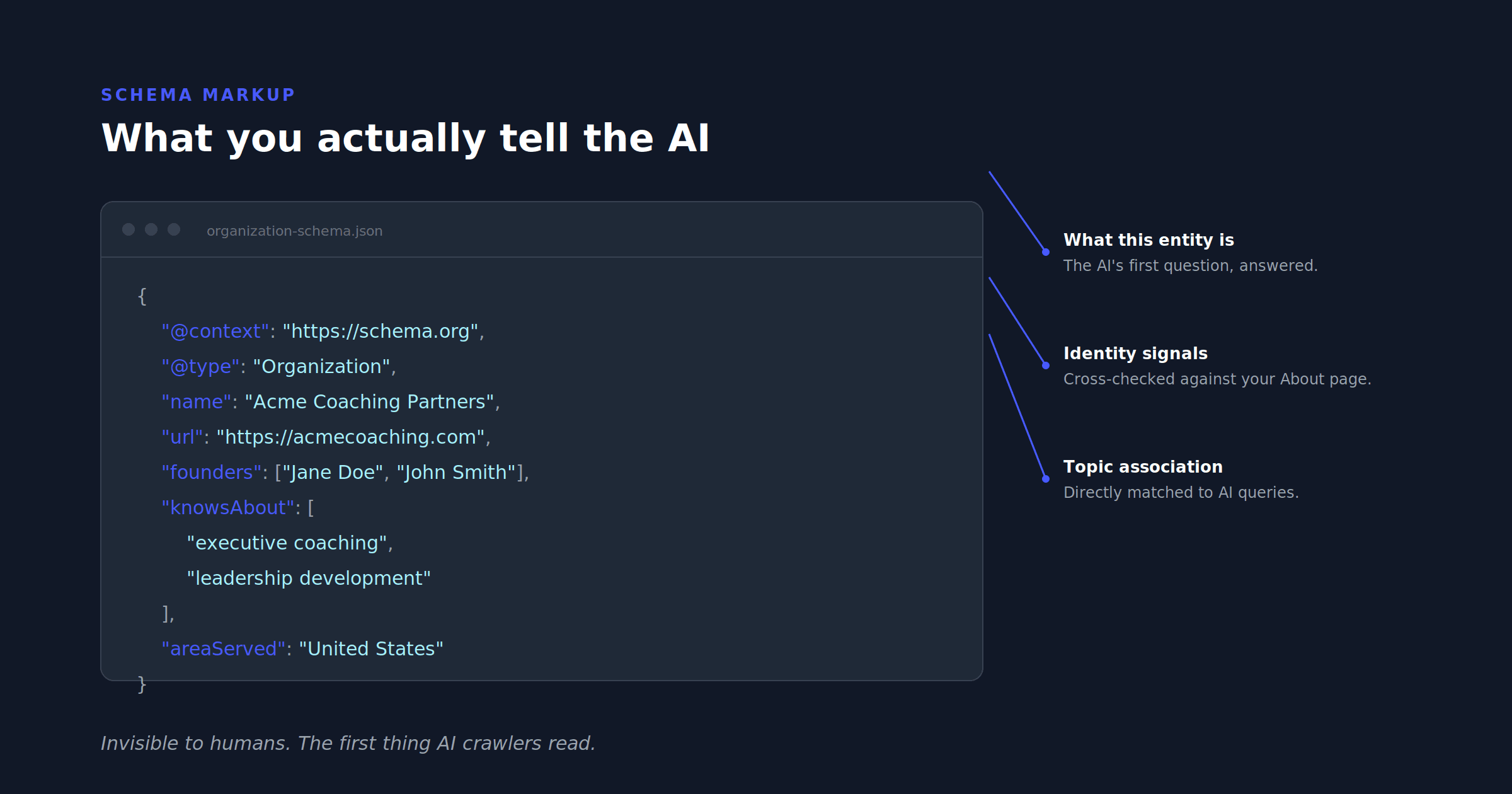
Schema markup is structured data embedded in a webpage that describes the page's content in a way machines can parse cleanly. It's invisible to human visitors — it lives in a <script> block in the page's <head> — but it's the first thing search engines and AI crawlers look for when trying to understand what the page is about.
The standard format is JSON-LD (JavaScript Object Notation for Linked Data), maintained by Schema.org. A simple example might describe a Service page like this: the page offers a service called Executive Coaching, provided by an organization called Acme Coaching Partners, served nationally, for an audience of CEOs.
A human reads the same content from the page's actual text and design. A machine doesn't. Without schema, a machine has to infer all of that from prose, page structure, and context. With schema, it's told directly.
Why this used to be a nice-to-have
For most of the last decade, schema markup did one main thing: it powered Google's rich snippets. Star ratings under search results. Recipe ingredient cards. Event dates. FAQ accordions on the search page itself.
For most businesses, those features were minor. A 5% lift in click-through from a star rating wasn't going to change the business. So schema went on the "we should probably do that" list and stayed there.
The standard advice was: implement Organization schema sitewide, maybe add LocalBusiness if you have a physical location, and call it done. That was enough for the Google-rich-snippets era.
Why it suddenly matters more
AI platforms are not Google. They don't crawl the web the same way, they don't rank results the same way, and — critically — they don't display the same way. There are no ten blue links. There's a paragraph naming two or three businesses by name.
When an AI platform decides whom to recommend, it draws on three main signals:
- Training data — what it learned during model training.
- Real-time web grounding — what it pulls from the live web when answering a query.
- Structured signals — what the page tells it directly via schema.
The first is fixed at training time. You can't change it. The second is partially in your control through traditional SEO and content publishing. The third — structured data — is the most direct lever you have. It's the page literally telling the AI what it is, who it's for, what it offers, and how it relates to other entities.
Businesses with thin schema force the AI to guess. The AI guesses guesses correctly sometimes and incorrectly other times. Businesses with rich, accurate, well-structured schema get a much more reliable read — and therefore a much more reliable shot at being included in the recommendation.
What rich schema means in 2026
The minimum useful schema for any business now includes:
Organization. Your business as an entity. Name, legal name, URL, description, founders, founding date, social profiles, contact information, and what topics you're known for. This is the foundational identity layer.
Service or Product. What you actually sell, with explicit descriptions, audience targeting, geographic scope, and pricing where applicable. This is the layer that gets matched against "what's the best [category] for [need]" queries.
Specific page types. AboutPage for your about page, ContactPage for your contact page, FAQPage for any FAQ content, BreadcrumbList for navigation. These tell the AI what each individual page is for.
Connections between entities. Critically, all of these need to reference each other correctly. The Service should reference the Organization. The AboutPage should mention the Organization. The contact information on multiple pages should be consistent. AI platforms reward coherence; they penalize confusion.
If you have a local service business, add LocalBusiness with areaServed as a structured geographic region — a GeoCircle with center coordinates and radius, or a Place with named regions, not just a string like "the Boston area." This single field is the strongest signal for "near me" queries on AI platforms.
A practical starting point
If you're starting from zero, the highest-leverage moves are:
- Add complete Organization schema to your homepage. Include social profile URLs, founders, and the topics that represent your category. Make the schema's identifier an absolute URL, not a relative anchor.
- Add Service or Product schema to each major service or product page. Include audience, area served, and offers where applicable.
- Validate your output against the Schema.org validator and Google's Rich Results Test. Both are free. Both will catch most common mistakes.
- Don't fabricate. If you don't actually have founders' names on your About page, don't put fictional ones in the schema. AI platforms cross-check structured data against page content, and inconsistencies hurt more than missing fields.
The bigger lesson
For years, schema markup was a marginal technical-SEO tactic — worth doing eventually, never urgent. AI changed that. It's now one of the primary signals platforms use to decide which businesses to recommend.
The good news: it's one of the few areas where the work is concrete, finite, and verifiable. You either have the right structured data on each page or you don't. The validator will tell you which is which.
Start there. The rest follows.
Schema is one of three levers — content depth and authority signals are the other two. The next post in this series breaks down what to actually pull, in what order, for most businesses. In the meantime: see what AI is recommending in your category.