
Google "how to improve AI visibility" and you'll find a lot of articles that read like a wishlist for a Fortune 500 marketing budget. Get featured in major publications. Build a Wikipedia page. Hire a PR firm to land you on industry best-of lists. Develop relationships with journalists at trade publications.
All of those tactics work. They also cost a lot of money and take a long time — and the businesses I work with usually don't have either luxury.
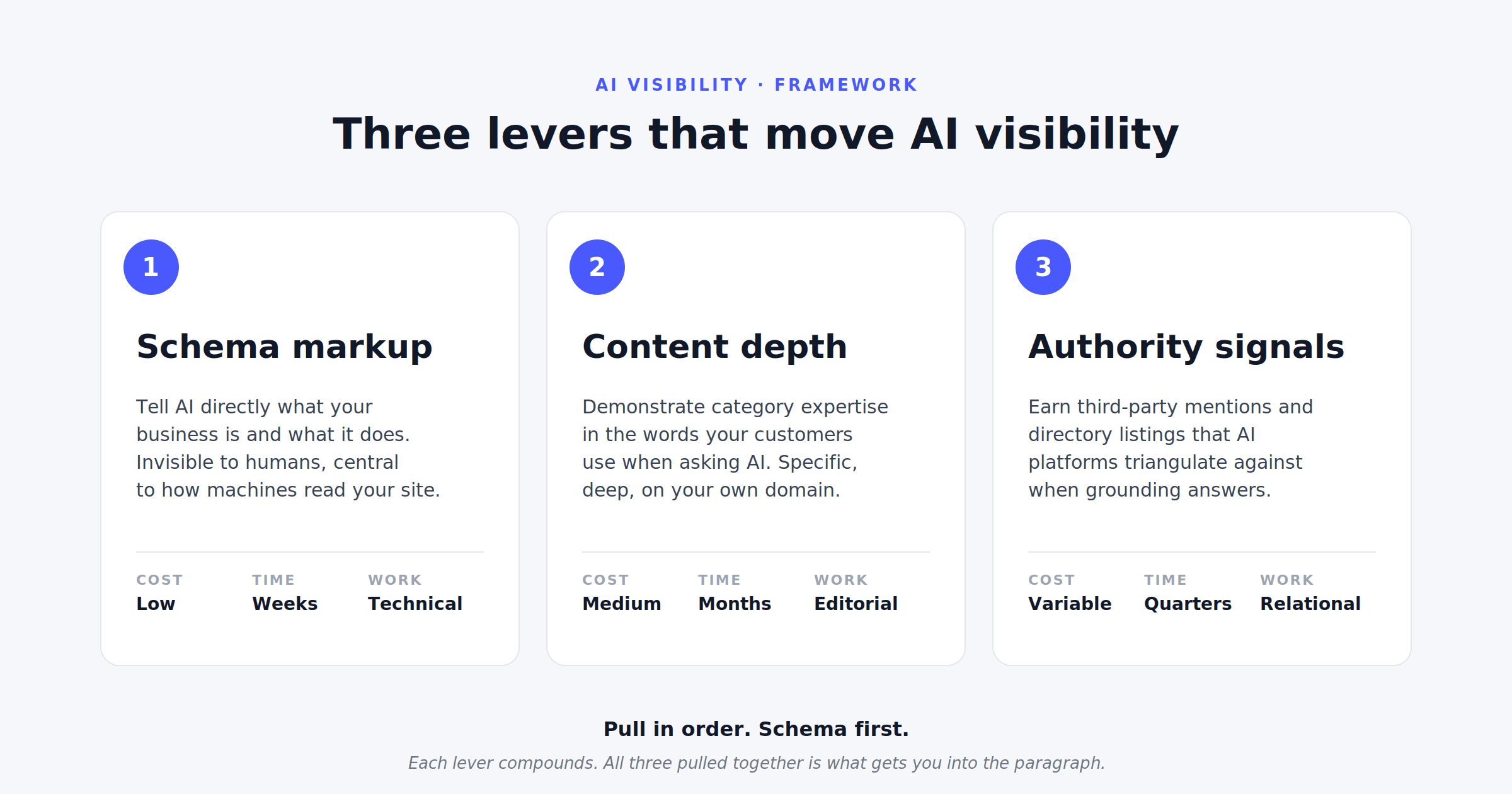
So this post is about what actually moves the needle for a normal business: one that doesn't have a PR retainer or a Wikipedia-worthy public profile. Three levers, in order of accessibility.
Lever 1: Schema markup
I've written a separate post on what schema markup is and why it matters now, so I won't repeat the full case here. The short version: schema is structured data embedded in your webpages that tells AI platforms what your business is, what it does, who it's for, and how it relates to other things. Invisible to humans, central to how machines understand your site.
Schema is the most accessible of the three levers because it's purely technical work. You don't need PR. You don't need executive bandwidth. You don't need budget beyond a developer who can edit your site's templates.
For most businesses, the minimum useful schema includes:
- Complete Organization schema on the homepage (name, URL, description, founders, social profiles, contact info, areas of expertise).
- Service or Product schema on each major offering page, with audience and area-served clearly specified.
- AboutPage, ContactPage, FAQPage, and BreadcrumbList schemas on the appropriate pages.
- LocalBusiness with structured area-served (GeoCircle or Place, not just a text string) for any local service business.
The work is finite. There's a known checklist. The output is verifiable through free tools (Schema.org Validator, Google Rich Results Test). And the impact on AI recommendations is real.
If you're going to do one thing this quarter, do this.
Lever 2: Content depth on category-defining topics
AI platforms recommend businesses that demonstrate expertise on the topics customers ask about. That expertise gets demonstrated through content.
But not all content. The AI doesn't care that you post twice a week to LinkedIn. It cares about content that:
- Goes deep on specific topics relevant to your category.
- Uses the actual terminology customers use when asking AI questions.
- Is hosted on your own domain — not just social media or third-party platforms.
- Reads as authoritative: clear claims, supporting evidence, useful detail.
A fractional CMO targeting SaaS founders should have substantive content on SaaS-specific topics — go-to-market, channel testing, CAC, retention strategy. Not generic marketing-blog content. Specific, deep, named-with-the-vocabulary-the-audience-uses content.
A local service business should have content explaining the actual service categories, the geographic service area, what's included, and how it works. Not generic "we deliver quality" copy.
Same pattern: content that matches the questions customers actually ask, hosted on your own site, with enough depth that the AI can extract meaningful answers.
A reasonable working target: four to eight substantial pieces of content per year, each targeting a category-defining question or topic. Not 50 posts of fluff.
Lever 3: Authority signals
This is where most AI-visibility advice lives — get press, get listed, get mentioned. Those work, but here's what's actually accessible to most businesses:
Get listed in the directories that actually matter for your category. Google Business Profile is the obvious one for local businesses. For B2B services it might be G2, Capterra, Clutch. For consultants, LinkedIn and your firm's own listing in trade associations. Don't chase every directory. Identify the two or three that customers in your category actually consult, and make sure your listings there are complete and accurate.
Earn third-party mentions through what you actually do. Publish original analysis. Run a study. Compile data nobody else has. Give a talk that gets posted online. Slower than getting a press placement, but these are the kinds of mentions AI platforms find when they're grounding answers — and they don't require a PR budget.
Make sure your existing mentions are findable and accurate. If you've been quoted in trade publications, make sure those pages are findable from your site. If you've been on podcasts, list them. If you've spoken at industry events, link to the talks. AI platforms triangulate across the web. The more accurate, consistent signals you give them, the more reliably they'll recommend you.
What I'd skip
A few tactics get mentioned in AI-visibility content that I'd specifically de-prioritize for most businesses:
Chasing Wikipedia. It's hard to get a Wikipedia page that survives, and most attempts fail. Spend that effort on schema and content instead.
Generic "thought leadership" content with no specific point of view. Volume without depth doesn't move the needle.
Expensive PR campaigns aimed at top-tier publications. They can work, but the cost-per-result is high. Better leverage usually exists in the first two levers.
Schema markup "tools" that add generic schema sitewide. Generic schema is mostly useless. The value is in specific, accurate, page-appropriate schema. A WordPress plugin that adds Organization schema to every page doesn't help you.
What changes when you do all three
The compounding effect of getting all three levers right is real. Schema gives the AI a clean, structured read on what your business is. Content depth provides evidence that you actually know what you're talking about. Authority signals give it external verification that other people think so too.
Each lever pulled alone helps. All three pulled together is what reliably gets you into the paragraph.
The order I'd work in: schema first (highest leverage, lowest cost), then content depth (highest leverage on an ongoing basis), then authority signals (slowest to compound, but most durable).
That sequence is doable for almost any business. The Fortune 500 marketing playbook isn't. Start with what's actually accessible.
Wondering which lever to pull first for your business? Start with a baseline — find out where you're actually being recommended and where you're not. Check your AI visibility.