A client asked me recently how their brand was ranking on Google. I asked them when they'd last opened ChatGPT to find a business themselves. They went quiet, then said "actually, I asked it where to get my brakes done last week."
That's the shift in one sentence. The same people who used to Google it are now asking AI. Not all of them, not all the time — but enough of them, often enough, that it's changing how businesses get discovered. And even when people do still search on Google, the first thing they see is often an AI-generated response sitting above the traditional results.
In February 2026, OpenAI confirmed ChatGPT crossed 900 million weekly active users — more than double a year earlier. ChatGPT alone processes around 2.5 billion prompts per day. And in OpenAI's own analysis of how people actually use the product, roughly half of all conversations involve some form of recommendation or advice-seeking: what's a good, which should I choose, who do you recommend.
Add Claude, Gemini, Perplexity, and Google's AI Overviews to that, and you have a discovery layer that simply didn't exist 18 months ago.
What's actually different
Two things have changed, and both matter for any business that depends on inbound discovery.
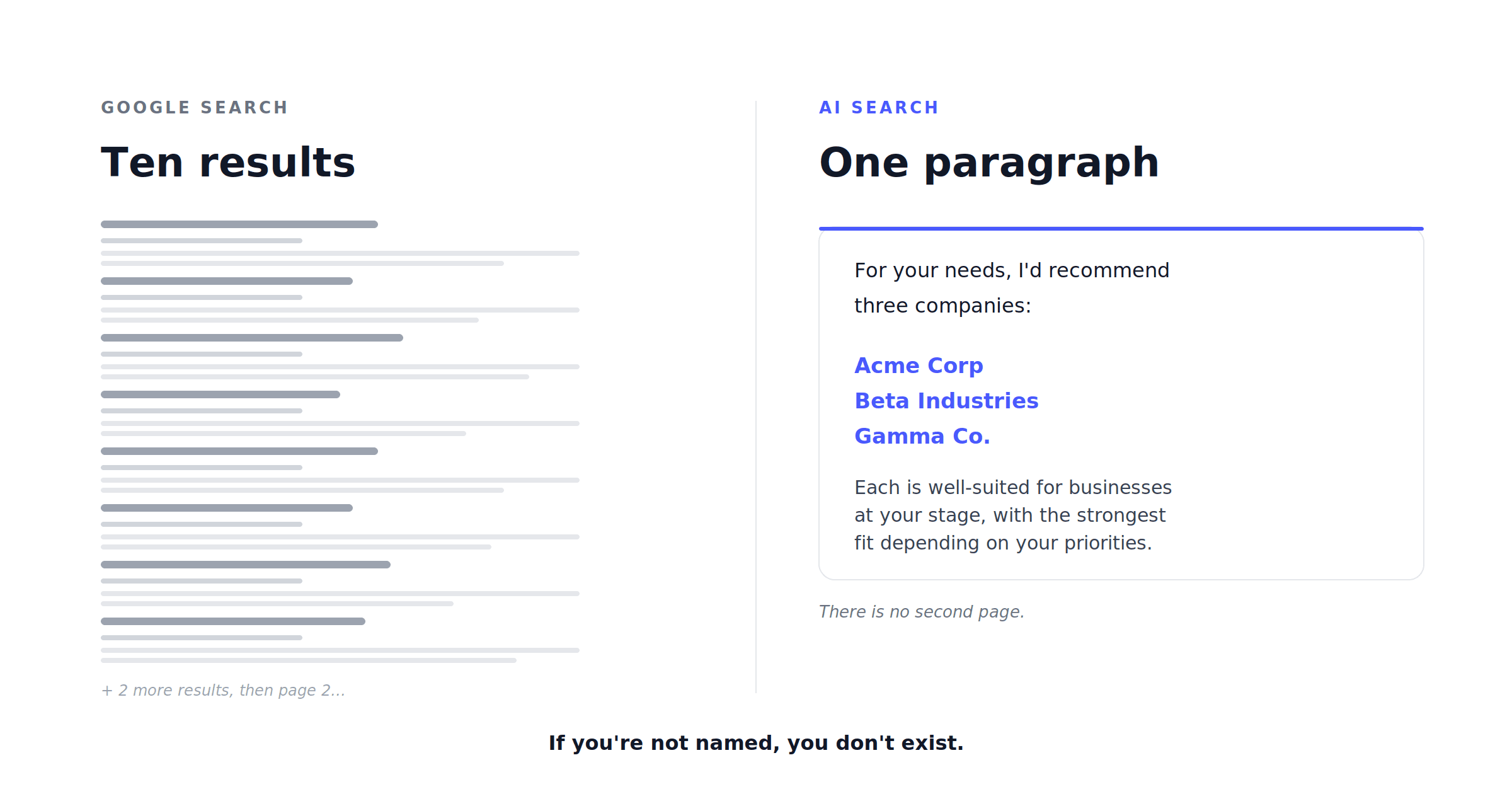
First, the format of the answer. A traditional Google search returns ten results on the first page, plus map listings, plus ads. Customers can compare, scroll, click through five tabs before deciding. AI search returns a paragraph. The paragraph mentions two or three businesses. Maybe four. There is no second page.
If you're one of the named businesses, you exist. If you're not, you don't.
Second, the user's behavior. When customers went to Google, they were entering a research phase. They expected to do work. AI users are asking a much more direct question — what's the best [X] for [Y] — and treating the answer as authoritative. They're not researching. They're shortcutting straight to a decision.
This is a real shift in funnel behavior. Recent analysis suggests ChatGPT referral traffic converts better than social media traffic and is approaching paid-search conversion rates. The visitor arriving from a ChatGPT recommendation has already moved past the comparison phase. AI did that for them.
Why most businesses are flying blind
Talk to any marketing team about their AI visibility right now and you'll hear one of three things:
- "We're not really sure how to measure that."
- "We checked once and we showed up, so we're fine."
- "It's too early to worry about."
All three are wrong. The third is the most dangerous.
You can't measure AI visibility the way you measured SEO. There's no rank tracker that asks ChatGPT the same query 200 times and reports the result. AI responses vary across runs, across platforms, and across slight wording changes. Single-snapshot checks are statistically meaningless. You need samples, multiple platforms, and a time series.
"We checked once and we showed up" is the same logic as running one A/B test, seeing a positive result, and declaring victory. The variation in AI output is real. So is the speed at which the platforms update. A business that gets recommended this week may not be recommended next week — and vice versa. You won't know unless you're measuring continuously.
And "too early" assumes the shift is still hypothetical. It isn't. ChatGPT alone has more weekly active users than X has monthly active users. Half of those conversations are about recommendations and decisions. Your customers are already there.
What to do about it
This is still new territory and best practices are forming in real time. But three things are clear:
Measure first. You can't improve what you don't measure. Get a baseline. Run real prompts your customers might ask, across multiple AI platforms, with enough samples per prompt to mean something. Find out where you actually stand before you do anything else.
Identify the gap. Once you know whether you're getting mentioned, look at who else is. The competitors AI names are doing something different — structurally, technically, content-wise. Often it's schema markup. Or it's depth of category coverage. Sometimes it's third-party citations that AI has indexed. The gap is diagnosable.
Make practical changes. A lot of advice in this space involves Wikipedia pages, PR campaigns, and expensive agencies. Those tactics can work but they're unrealistic for most businesses. The practical changes — schema markup, page structure, content depth on category-defining topics — are accessible to almost anyone. Start there.
The bigger picture
Search isn't going to stop changing. Google itself is integrating AI answers into its core search results page. Voice assistants, browser-native AI, and agentic shopping flows are all on the near horizon.
The businesses that adapt early to AI discovery will get the same kind of advantage that early SEO adopters got 15 years ago: discoverable while the rest of the market is still arguing about whether the shift is real.
The shift is real. It's measurable. The businesses that get ahead of it now will be the ones AI keeps recommending five years from now.
Want to see where you actually stand? LLMLens runs real prompts across ChatGPT, Claude, Gemini, Perplexity, and Google AI — and shows you whether your business shows up. See how it works or check your AI visibility.